The Jesuits of Bellarmine House
— Story by Rachel Amiri
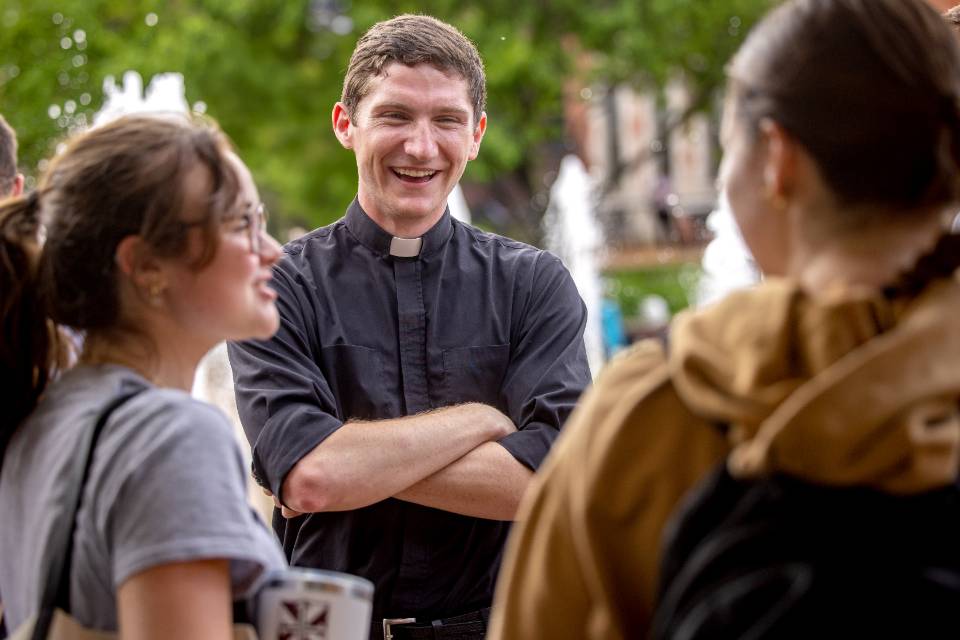
Not far from the campus of Saint Louis University (SLU) sits a row of century-old
houses brought together by a singular mission. The Bellarmine House of Studies is
one of two houses of first studies in the Jesuit Conference of Canada and the United
States where Jesuit scholastics and brothers dedicate three years to study and continued
growth in Jesuit identity after pronouncing perpetual vows.
“They’re engaging culture, they’re engaging history, they’re engaging the life of
the mind for the service of faith and the promotion of justice, to serve the people
of God,” said Tim Kesicki, S.J., who has served as rector since 2024.
During their time at Bellarmine, Jesuits in formation work to integrate rigorous academic
studies with prayer, community life and apostolic service. As they prepare for future
ministry, they learn to hold the balance, Kesicki said.
“We’re here for intellectual formation and for ministry, but we’re also here to learn
how to manage our time with all of these competing interests and opportunities,” said
Tom Laughlin, SJ a first-year scholastic from the USA Central and Southern Province.
“How do you say yes to things? How do you say no to things? And how do you find ways
to set aside time for prayer?”
“Making mistakes, asking for help and praying about all of it becomes a balancing
act,” said Rajae Clarke, S.J., a scholastic from the Jesuits USA East Province. “The
minister here, Glen Chun, S.J., told me: ‘This is where you learn how you’re going
to be a Jesuit.’”
Daily Order
On a typical day, 22 Jesuits in formation from each of the provinces of the United States, Canada and the Caribbean fill the floors of the Bellarmine House with activity. Along with their formators and Jesuits in residence or pursuing language studies from around the world, the men number 29; the average age of the lively community is 35.
There's a certain ‘pray together, work together’ mentality to the house.”
Tim Kesicki, S.J., rector of Bellarmine House
The Jesuit scholastics put it more succinctly.
“Above all, we have a lot of fun,” said Mike Mateo-Sebastian, S.J., a scholastic from the Jesuits USA West Province. Game and movie nights, Jesuit-prepared dinners showcasing diverse cuisines, outings and athletics, like the annual basketball game against the Dominicans, round out community life. There’s always a brother Jesuit willing to offer encouragement, too.
“I love this house. I love my community. It's been the biggest blessing,” Clarke said. “We're failing together, we're succeeding together, we're forming our Jesuit identity together.”
The daily routine is rooted in prayer: daily Mass, typically attended in community, as well as an hour or more of personal prayer. Community Mass flows directly into social and dinner, connecting the liturgy with the spiritual conversation and fellowship that follow.
Laughlin, who resides in the chapel house at Bellarmine, often starts his day there. “Even though there’s this long list of things to do, silence for an hour and entering into conversational prayer with Jesus is foundational,” he said.
Academic Formation for Ministry
“SLU has a long tradition of teaching Jesuits. It’s the strength of the university that keeps us here,” Kesicki said, pointing to the school’s recent “R1” Carnegie classification. “It can offer the full range of philosophy, theology and other disciplines required for first studies,” he added.
As a house of first studies, Bellarmine welcomes Jesuits from diverse academic backgrounds, from those who need to complete their undergraduate education to those who have already earned a Ph.D. The dean of the College of Philosophy and Letters, Randy Rosenberg, Ph.D., supports the rector and assistant rector in tailoring each Jesuit’s academic program to his and the Society’s needs.
“We want them to be as engaged in a broad, humanistic course of study as we do in the more specific study of philosophy and theology,” Kesicki said.
This foundation prepares Jesuits for future study and to serve in full-time apostolic ministry during regency, a time when many Jesuits find themselves teaching.
“None of us is here because we only want to study. We're here because we want to have a closer relationship with God, and in turn that makes us want to want to serve the people and engage in community life. This is, for me, the work of first studies,” Clarke said.
“We're always encouraged in our studies to make connections to our Jesuit identity, to the mission of the Church,” Mateo-Sebastian said. A seminar on Jesuit history taught by Thomas Flowers, S.J., assistant rector and professor of Ignatian formation, underlines the uniquely Jesuit approach to study and apostolic work.
The setting at SLU brings the men in formation alongside other students, both religious and lay. “We have this really formationally intense and fruitful kind of setting where this integrating work is welcomed in the classroom,” Rosenberg said. In recent years, the College of Philosophy and Letters has expanded to include undergraduates in the Catholic Studies academic program, diocesan seminarians from Kenrick-Glennon Seminary, as well as religious in formation for the Dominicans and the Handmaids of the Sacred Heart.
“That shared classroom becomes a space where intellectual rigor, faith and vocation are not separated but brought into conversation in a way that is both demanding and deeply life-giving,” Rosenberg said.
“The men in formation play a vital role in animating the spiritual and faith life of the university,” Kesicki said. They assist with programming at the Catholic Studies Center and staff retreats through campus ministry, and with liturgies.
“Java with the Jesuits,” a weekly drop-in event featuring coffee, treats and spiritual conversation on Saint Louis University’s main campus, is an opportunity to connect with students outside the classroom.
“There's a good community of familiar faces, as well as new students each week. There's a lot of spiritual conversations, students asking questions. You never really know what the questions will be,” Laughlin said. “It’s enlivening.”
Their presence has a “larger than life impact” on campus, Rosenberg says. “So many other SLU students point to Java as an experience that is meaningful for them. They’re really an important presence.”
In the Service of the Apostolate
“While the primary focus of first studies is on academic and intellectual formation, studies are in service of the apostolate,” Kesicki said. Because of this, each Jesuit engages in service to the poor and those on the peripheries. Flowers, the assistant rector of Bellarmine House, assists in selecting sites for apostolic ministry and regularly meets with Jesuits about their experiences.
“For me, it is natural that I also accompany the men in their ministerial work, because it is a place where they receive practical formation in how to live out this Jesuit charism amid the complications and beauty of service among the poor and marginalized,” Flowers said.
Mateo-Sebastian serves in the Abriendo Puertas program of St. Francis Community Services, a ministry of Catholic Charities serving new arrivals in the St. Louis area. A Guatemalan American immigrant himself, Mateo-Sebastian supports case managers and assists with translation and job-interview training.
“[Apostolic work] has helped ground me,” he said. “What’s been emphasized here is that our apostolates are also part of our intellectual formation. I’ve been very grateful for the knowledge to bridge those two things.”
Clarke assists with the ID program at St. Francis Xavier College Church, a long-standing outreach effort to assist residents with obtaining legal identification documents.
“My job there is to provide the service and be attentive to what's going on in me as I provide that service,” he said. “It's difficult. You speak to ten people for 15 minutes on a Tuesday, and that experience travels with you throughout the whole week. You're in class thinking about it. You're reading things, you're thinking about it. You're in prayer. All these things are connecting.”
A Privileged Time
The integration seminar Rosenberg teaches helps Jesuits make connections between thinking, feeling, judgment and action.
“What my class asks students to do is learn how to think reflectively about real human experience – especially experiences of service, leadership, and ministry – rather than just talking about ideas in the abstract,” he said.
This integration class brings that all together, which I think is, for me, the work of first studies,” Clarke said.
The three years at Bellarmine House provide time to grow as Jesuits who are equipped to serve as available and reflective ministers in the Church.
“I view these three years as a privileged time for continuing the internal work to get greater self-knowledge, greater interior freedom, so that when I can go back to full-time ministry, I'm even more free to be of generous service to others,” Laughlin said.
“We are growing in a holistic understanding of the many ways that one could be a Jesuit,” Mateo-Sebastian said. “Always rooted in Christ, loving God, always serving the Church, but we all bring our own personalities to the table. Seeing how to do that has been a grace.”
Explore a Jesuit vocation or learn more about the stages of Jesuit formation at beajesuit.org.